
Vicious and Virtual Circles: Shaping a Nation's Destiny
As for gains granted by Allah to His Messenger.. they are for .. orphans, the poor, and ˹needy˺ travellers so that wealth may not merely circulate among your rich. (Quran 59:7)

Daron Acemoglu and James Robinson are prominent economists and co-authors of “Why Nations Fail”. They use the concepts of Virtuous Circles and Vicious Circles to describe the self-reinforcing mechanisms within societies and their institutions that lead to divergent paths of development. Institutions here refer to Political and Economic institutions. Political institutions includes various branches of government, such as the legislative, executive, judiciary, and bureaucracy, while Economic institutions include the government's economic policymakers, the central bank, the general banking structure, and so on.
These ideas are central to their Institutional theory for which they received Nobel Prize in economics along with Simon Johnson. In this theory, they argue that that societies which have inclusive institutions lead to sustained prosperity, while extractive institutions perpetuate stagnation and inequality.
Virtuous Circle
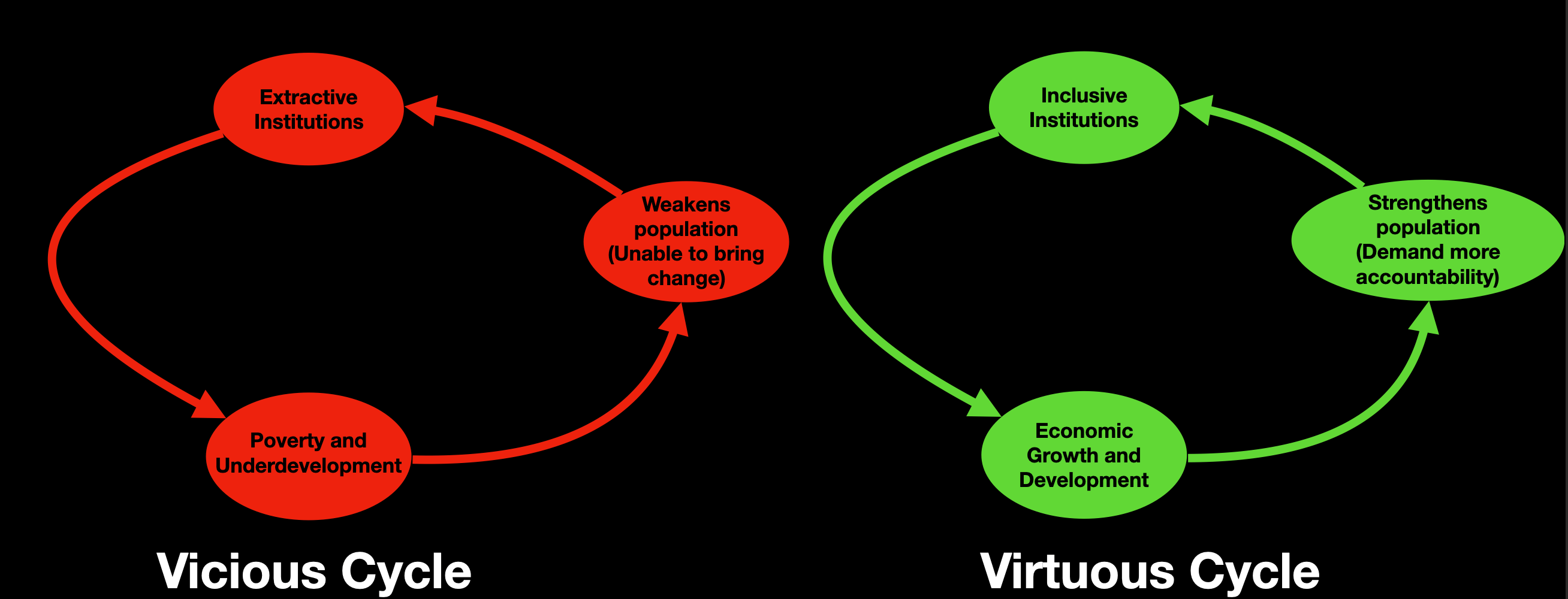
A virtuous Circle refers to a self-reinforcing positive feedback loop where inclusive political and economic institutions create conditions that foster further inclusivity and prosperity. These institutions encourage innovation, equitable resource distribution, and the rule of law, which, in turn, reinforce social stability and economic development.
Key Features of Virtuous Circle:
Inclusive Political Institutions: Power is distributed broadly, encouraging participation and limiting domination by elites.
Inclusive Economic Institutions: Equal opportunities for individuals to engage in economic activities without barriers imposed by monopolies or political constraints and most importantly bureacracy.
Feedback Mechanism: These institutions generate prosperity, which strengthens middle-class power and fosters demand for greater accountability and democracy.
Examples:
Rashidun Caliphate: The Meccan society in the pre-Islamic era was highly extractive, both politically and economically. Power and wealth were concentrated in the hands of a small elite, marginalizing the majority of the population. However, in the Islamic era, during the Rashidun Caliphate, both political and economic institutions became significantly more inclusive. Governance under the caliphate emphasized consultation (shura), justice, and accountability, fostering broader participation in decision-making. Economically, the redistribution of resources, such as through zakat (mandatory almsgiving) and fair taxation, aimed to reduce inequality and support social welfare. This inclusivity contributed to the stability and expansion of early Islamic rule, which in turn fostered further inclusivity until it eventually eroded under the establishment of monarchy.
Britain after the Glorious Revolution (1688): The Glorious Revolution established constitutional limits on monarchic power and empowered Parliament, representing broader societal interests. Inclusive political institutions allowed for the development of secure property rights and protection of innovation, leading to the Industrial Revolution.
United States (19th Century): Post-independence, the U.S. developed a constitution that emphasized checks and balances, ensuring a broad distribution of political power. Inclusive institutions like public education systems and patent laws spurred innovation and upward mobility, reinforcing political inclusivity.
Over time, the virtuous circle ensures that wealth and power do not become concentrated, preventing stagnation and ensuring sustained development.
Vicious Circle
A Vicious Circle is the opposite of Virtuous Circle. It is a self-reinforcing negative feedback loop where extractive political and economic institutions perpetuate inequality, stagnation, and conflict. In these systems, elites consolidate power and wealth, suppress opposition, and undermine efforts to create inclusivity, further entrenching their dominance.
Key Features:
Extractive Political Institutions: Power is concentrated in the hands of a few, often through authoritarianism or oligarchy.
Extractive Economic Institutions: Resources and wealth are monopolized by elites, suppressing competition and innovation.
Feedback Mechanism: Concentration of power and wealth creates resistance to reform, leading to further exploitation and stagnation.
Examples:
South Africa during Apartheid rule: Following its independence in 1910, South Africa's policies of racial segregation evolved into the apartheid system in 1948, institutionalizing deep economic and social inequalities. The government concentrated power and resources in the hands of the white minority, creating an extractive system that marginalized the black majority. This exclusion led to widespread poverty and social unrest, which the regime responded to with increased repression, further entrenching the circle of inequality and instability. The lack of inclusivity perpetuated economic stagnation for the majority population, fueling resistance movements that eventually culminated in the end of apartheid in 1994. Similar Vicious circle is in play in Occupied Palestinian territory since 1967.
Zimbabwe under Robert Mugabe: After independence, Zimbabwe began with some inclusive policies, but Mugabe’s regime increasingly centralized power. Land seizures, economic mismanagement, and suppression of dissent led to hyperinflation and economic collapse, reinforcing the regime’s extractive nature. In a vicious circle, the lack of accountability and concentration of power stifle economic growth and foster social unrest, making reform difficult.
Interplay Between Virtuous and Vicious Circles
Acemoglu emphasizes that transitions from vicious to virtuous circles require significant institutional change. This often involves a critical juncture, such as a revolution or a major political crisis, that disrupts the existing power structure. During these moments, broad-based coalitions demanding reform may emerge, leading to the establishment of more inclusive institutions.
However, virtuous circles are not guaranteed to persist. If institutions become captured by elites or fail to adapt to changing circumstances, they can deteriorate back into vicious circles. For example, corruption, cronyism, or a decline in the rule of law can erode the benefits of inclusive institutions and lead to a resurgence of inequality and economic stagnation.
Therefore, maintaining a virtuous circle requires ongoing efforts to strengthen institutions, promote transparency, and ensure accountability. This involves a continuous process of reform and adaptation to ensure that the benefits of economic growth are shared widely and that the foundations of inclusive institutions are preserved.
Example of Transition:
Transition of Pagan Arabia to Islamic rule: The Pre-Islamic Arabia was filled with extractive institutions. After the bloodless conquest of Mecca by Prophet Mohammed (PBUH), Arabia began to develop more inclusive institutions than the extractive ones previously in place. The system of Zakat, shura, the establishment of a strong education system, and a social welfare system all contributed to the creation of a virtuous circle.
South Korea (Post-1960s): Initially marked by extractive political institutions under military rule, South Korea transitioned to democracy in the late 1980s. The change was pushed by the economic reforms and democratization which created inclusive institutions, fostering sustained growth and innovation.
Example of Regression:
Russia (Post-1990s): After the collapse of the Soviet Union, Russia experienced a period of potential inclusivity. However, under Vladimir Putin, power became increasingly concentrated, leading to a return of extractive institutions.
Conclusion
The concepts of virtuous and vicious circles underscore the critical role of institutions in shaping a nation's trajectory. Inclusive institutions create self-reinforcing prosperity and stability, while extractive institutions entrench inequality and stagnation. Understanding these dynamics provides valuable insights into why some nations succeed while others fail, and what it takes to escape the traps of the vicious circle.
Great article!