
Understanding Inequality: Its Forms, Causes, Measurement, and Harms
“Every inequality needs a justification. Without it, the whole political and social structure stands in danger of collapse.” — Thomas Piketty, French economist specializing in the study of inequality


Inequality is not just a statistic or a policy debate. It is one of the defining realities of the modern world. It shapes who gets to dream and who must struggle, who speaks and who is silenced, who leads and who is led. It influences how societies organize themselves, how nations imagine justice, and how the world order defines human worth. To study inequality is to examine how power, wealth, and dignity are distributed across the human landscape.
This article explores what inequality is, why it exists, how it is measured, and why it matters, drawing upon both Islamic and Western intellectual traditions.
What is Inequality
Inequality refers to differences in access to resources, opportunities, rights, and power among individuals or groups within a society, or between societies and nations. Scholars continue to debate whether inequality within a society is more pressing than inequality between nations. However, with the growing impact of climate change, and geopolitical conflicts, the issue of global inequality is gaining increasing attention. This article restricts the discussion to intra-society inequalities (i.e., inequalities within a society).
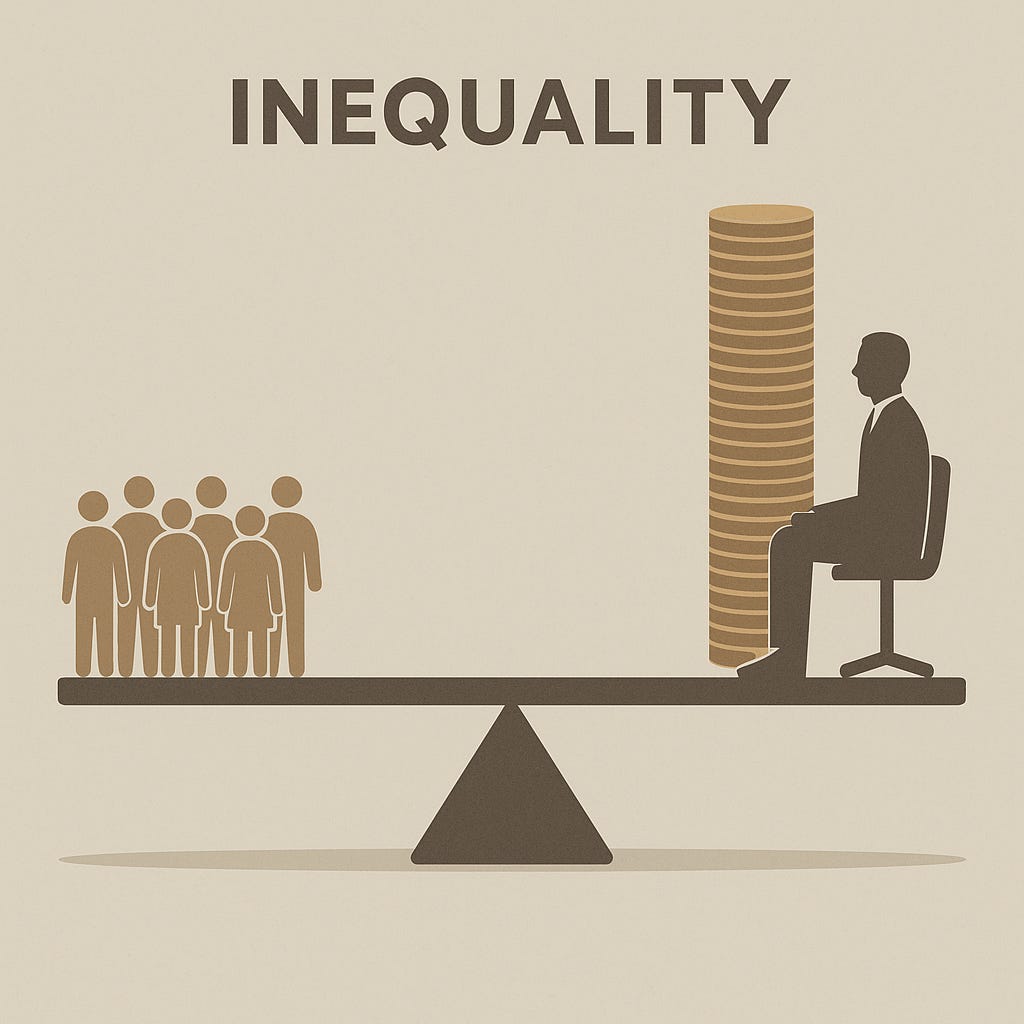
Inequality is not just about income or wealth. It affects almost every aspect of life. Inequality can appears in:
Economic inequality: uneven distribution of (1) income and (2) wealth.
Educational inequality: unequal access to quality education.
Health inequality: differences in access to medical care and health outcomes.
Political inequality: unequal ability to influence decisions and policies.
Social inequality: differences in dignity, respect, and treatment based on class, gender, race, ethnicity, or religion.
We cannot have a utopian equality as envisioned by Plato or Marx. The real issue, however, arises when inequality becomes excessive, entrenched, and self-reinforcing. A particularly concerning feature is its cross-dimensional impact: for example, educational inequality can lead to economic inequality, which in turn shapes political inequality. When these compounding effects take hold, inequality shifts from being a normal feature of human diversity to becoming a structural problem.
Why Inequality Exists
Inequality arises from many interlocking causes. Some are historical, others are structural, and some are driven by deliberate choices and policies.
Historical Privilege and Dispossession
Colonialism, slavery, caste hierarchies, and feudal systems created deep layers of inequality. Those who accumulated wealth and power historically often passed it forward through laws, inheritance, and institutions.Unequal Access to Education and Skills
Education is a key pathway to opportunity. When education is expensive, unequal, or limited, inequality multiplies across generations. In an economy based on Division of labor, education and skills derived from it are directly translated to unequal earnings.Dynamics of prevailing economic Systems
Modern economies reward those who own assets (land, companies, technologies, financial instruments) more than those who work for wages. This means wealth grows faster for investors than for workers. Thomas Piketty shows that the average rate of return on capital (R) is approximately 4–5 percent, while economic growth (G) in the Western world has averaged around 1–1.5 percent. This gap, R > G, is one of the leading causes of rising inequality according to Piketty, especially when combined with inherited wealth, as discussed in (1).Three main factors in the economic system that cause inequality and exacerbate wealth inequality are:
Division of labor: High-skilled workers are paid more than low-skilled workers.
Automation: People whose jobs can be replaced by automation are more vulnerable to income loss.
Ease of capital acquisition: Those who already have capital can acquire more assets, invest more easily, and compound their wealth faster.
Political Power Concentrated Among the Wealthy
When the wealthy influence lawmaking, tax rules, trade policies, or media narratives, they shape the system to protect their interests. As Joseph Stiglitz notes, “Inequality is not an accident. It is a policy choice.”Social Status and Cultural Bias
Gender, race, class, or tribe often shape access to opportunity. Social norms can exclude whole groups from advancement.
Inequality persists because systems are arranged to reproduce themselves. The wealthy do not simply have money. They have networks, influence, confidence, and time, all of which reinforce advantage.
How Inequality is Measured
Economists and social scientists have developed various tools to measure inequality. Many forms of inequality, including wealth inequality, are difficult to measure accurately. Some key measures are listed in the table below:
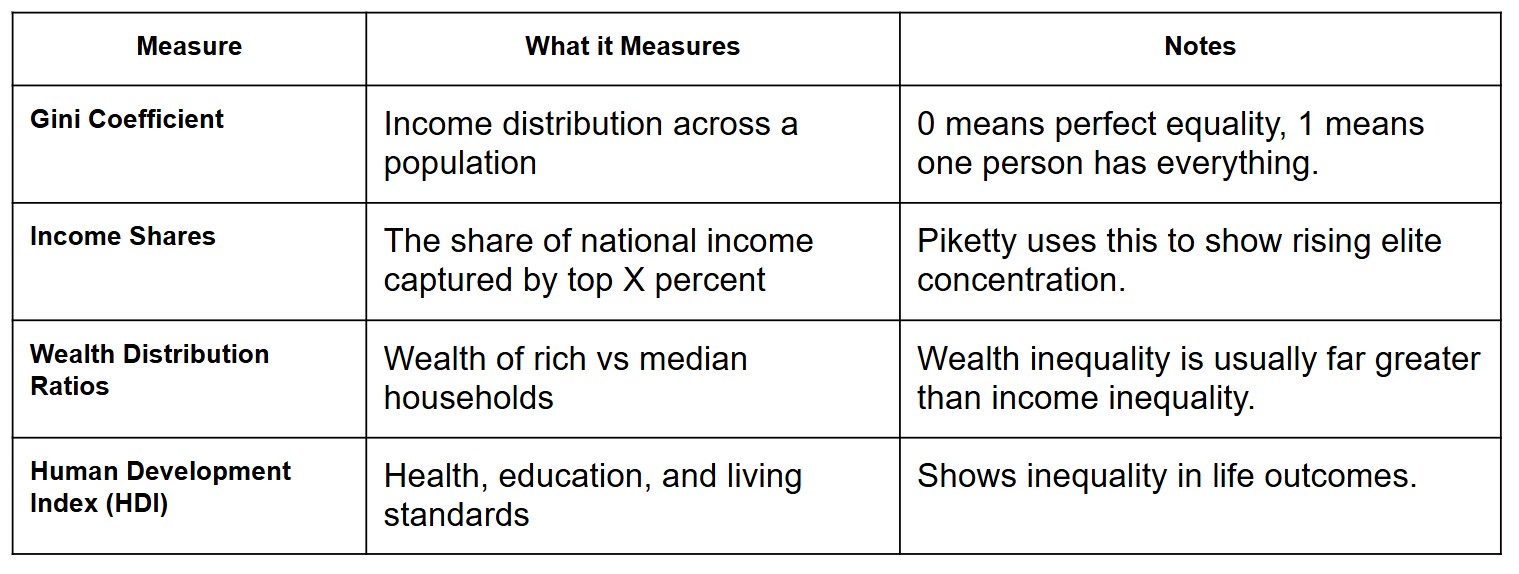
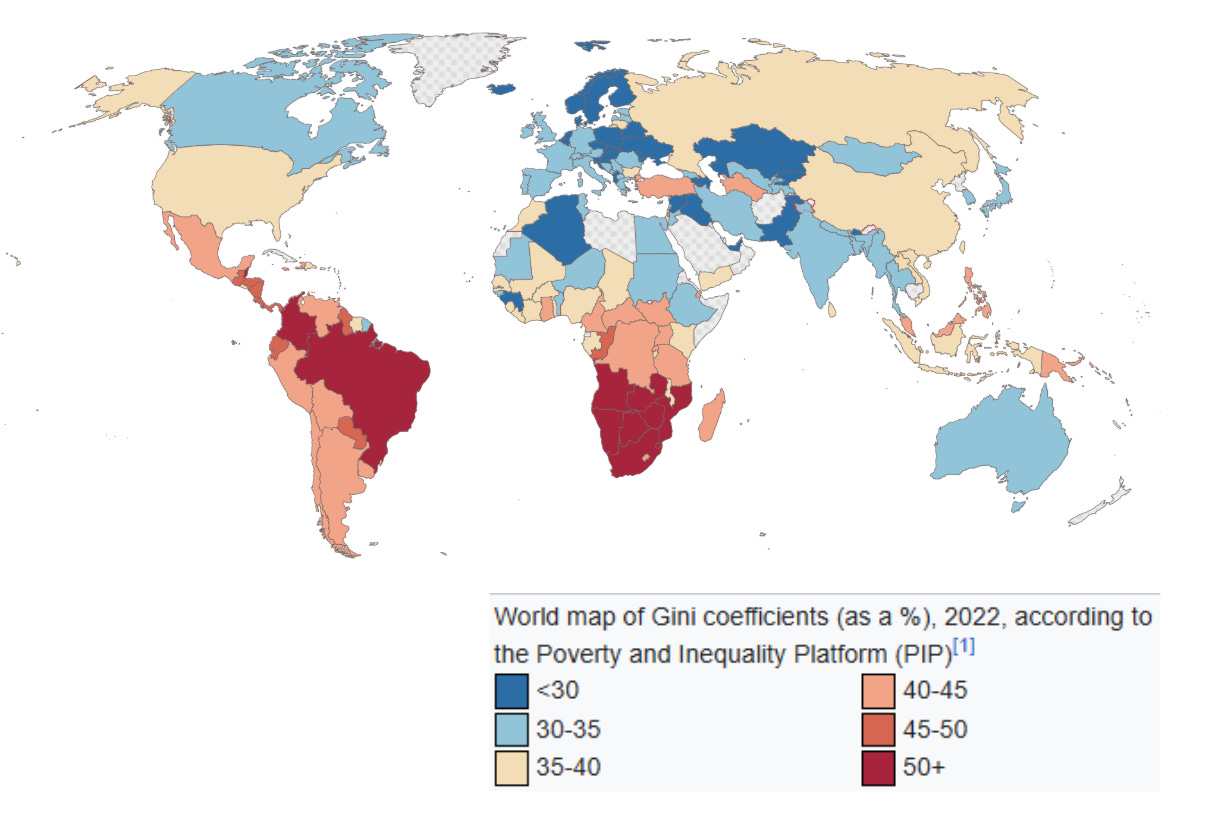
It is important to note that these metrics only give partial picture and has to be seen in conjunction with many other metrics to get a complete picture. In many cases, it is important to consider the entire distribution, because the variation within deciles (10% blocks) can be substantial, and even within the same percentile (1 %) there can be significant differences in wealth or income.
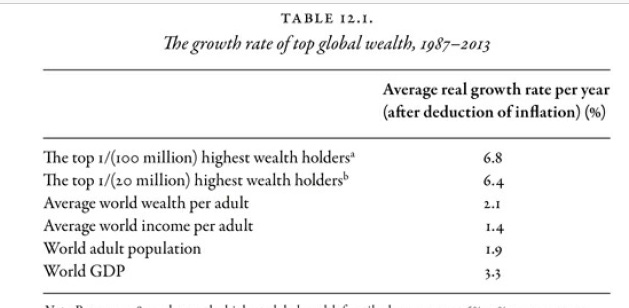
Recent global research, especially from Thomas Piketty, Emmanuel Saez, and Gabriel Zucman, demonstrates that inequality has increased sharply since the 1980s. The top one percent now owns more wealth than the bottom half of the world combined.
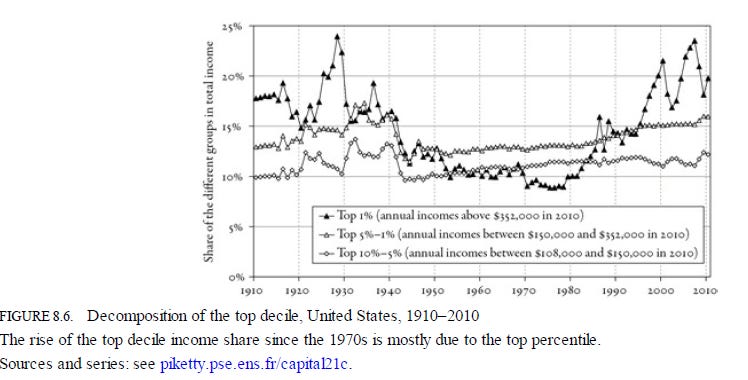
Not only does the top percentile owns more, but they also they grow their wealth faster.
Harms of Inequality
The harm of inequality is not only material. It is psychological, social, political, and civilizational.
Weakening of Social Cohesion
When large segments of society feel excluded, trust declines and resentment grows. Shared identity erodes.Loss of Opportunity and Human Potential
Talented individuals born in poverty may never realize their capabilities. Inequality wastes human creativity.Distortion of Democracy
When wealth influences elections, policy agendas, and media landscapes, democracy becomes government of the wealthy, by the wealthy, for the wealthy.Stress, Anxiety, and Social Comparison
Research in behavioral psychology shows that high inequality correlates strongly with mental health problems, violence, and isolation.Economic Instability
Stiglitz argues that inequality reduces consumer demand, slows growth, and increases financial crises because wealth concentrates in stagnant capital rather than productive investment.
Reflections on Inequality
Islamic moral and legal systems place a strong emphasis on preventing wealth from concentrating in the hands of a few. The Qur’an says:
“…so that wealth does not merely circulate among the rich among you.” (59:7)
This principle forms the basis of zakat, inheritance distribution, prohibition of hoarding, and the discouragement of monopolistic practices, all of which are key to reducing inequality. In addition, the condemnation of Riba (interest on loans) emphasizes that wealth should not grow simply by virtue of ownership, but through productive contribution and fair exchange.
Imam Al-Ghazali argued that wealth is a trust, not absolute property, and warned that society collapses when compassion and economic justice are not maintained. For him, inequality was a moral failure, not just an economic one.
Ibn Khaldun also highlighted the dangers of inequality in the 14th century, noting that “injustice (especially in the form of hoarding wealth) destroys civilizations” and that “Group feeling is necessary for the protection of property and life”.
Many Islamic scholars, ranging from Allama Iqbal to Maulana Abul Ala Maududi to Dr. Tariq Ramadan, have stressed that inequality harms society because it erodes the moral fabric and shared responsibility of the community.
Thomas Piketty shows historically that unchecked capitalism tends toward extreme concentration of wealth. His work reveals that inequality is not natural, but shaped by laws, taxation, and public policy.
Joseph Stiglitz argues that inequality damages not only the poor, but the economy and democracy as a whole. A system that favors wealth over fairness cannot sustain collective progress.
Both argue that reducing inequality is necessary for a stable, humane society.
Conclusion
Growing inequality is not an accidental feature of society. It is shaped by history, institutions, culture, and choices. It affects who thrives and who struggles. It shapes the dignity, security, and psychological well-being of individuals. Both Islamic scholars like Ghazali and Ibn Khaldun, and modern economists like Piketty and Stiglitz, emphasize that excessive inequality is dangerous for the soul of the individual and the stability of society.
Reducing inequality is not simply a matter of economics. It is a moral and civilizational responsibility.
In future posts, we will explore practical approaches societies can take to address inequality in a just and sustainable way.
References:
Piketty, Thomas. Capital in the Twenty-First Century. Cambridge, MA: Harvard University Press, 2014.
Stiglitz, Joseph E. People, Power, and Profits: Progressive Capitalism for an Age of Discontent. New York: W.W. Norton & Company, 2019.
 | A guest post by
|
Nice post. Jazakallahkhair