
On Structural Limits: Why Communities Struggle to Advance
We are so bound by the structures of society that we confuse them with our own nature.— Erich Fromm, German-American social psychologist, philosopher


In many debates across economics, politics, and social reform, explanations tend to focus on individuals and events. Failures are blamed on pandemics, wars, bad leaders, corrupt bureaucrats, lazy workers, or misguided voters. Success is also credited to exceptional visionaries or heroic reformers. Structuralism challenges this way of thinking. It argues that outcomes are produced, and often persist, not primarily because of individuals and events, but because of the underlying structures that shape the choices people can realistically make.
In sociology and political science:
Agency is the capacity of individuals or groups to act independently, make choices, and exert power, even within the constraints of social structures.
Structure refers to social forces, such as class, norms, institutions, and incentive systems, that constrain, channel, or enable those choices.
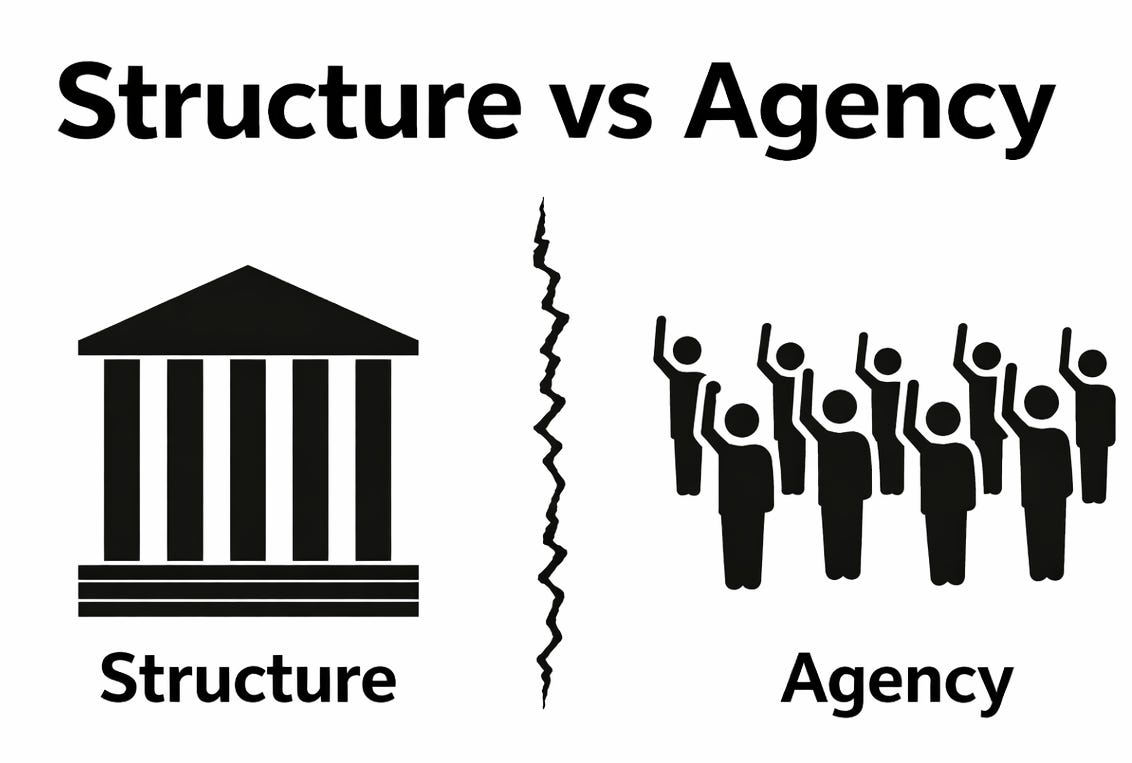
Various sociologists and political scientists weigh agency and structure differently when analyzing a situation. The importance of social structure is discussed in the work of Ibn Khaldun, often regarded as the father of sociology, through his concept of ʿasabiyyah (social cohesion or group solidarity).
In the modern era, at one end are Karl Marx and other Marxists (such as Louis Althusser), who place heavy emphasis on structural forces, especially economic and institutional constraints. Then there are thinkers such as Anthony Giddens, Pierre Bourdieu, Margaret Archer, and Thomas Luckmann, who occupy more nuanced positions along the agency–structure spectrum, emphasizing in different ways that structure and agency interact, and that the status quo is maintained through their ongoing interplay.
Then there are thinkers such as Paul Pierson who emphasize how timing and major events (like World Wars) can redirect long-term outcomes. However, such thinkers also treat institutions and structural constraints as crucial to understanding how societies and states actually operate. Even individualist thinkers like Karl Popper also emphasized the role of social structure in their analysis.
For these reasons, structuralism is widely treated as a serious and indispensable lens for explaining persistent social outcomes.
What is Structuralism?
Structuralism is an approach in the social sciences that seeks to explain the situation of a society (behavior, meaning, and outcomes) by examining how society is structured, rather than focusing primarily on individual actors or isolated events.
Social structure is understood as the pattern of relations among economic, political, legal, linguistic, and cultural systems. These systems share a common property emphasized by Émile Durkheim, namely that they operate as social facts that are durable, impersonal, and slow-moving, exerting constraint over individual action.
The intellectual roots of structuralism are often traced, loosely, to linguistics (Ferdinand de Saussure) and, more indirectly, to early psychology (Wilhelm Wundt). In linguistics, Saussure argued that words get their meaning from their relations and contrasts with other words in the language system (for example, “hot” is defined partly by not being “cold”), not from any meaning built into the words themselves. This insight was later extended in anthropology by Claude Lévi-Strauss, and it resonates with earlier emphases on social structure in sociology (eg. Émile Durkheim) and in political economy (eg. Karl Marx).
Across these fields, the shared claim is simple: individual actions make sense only within structured contexts.
What are Structural Factors?
Structural factors are the persistent conditions that shape incentives, constraints, and expectations across a society. They do not determine outcomes mechanically, but they heavily bias what is possible, likely, or sustainable [1].
Some of the most important structural factors include:
Economic structures
These include the mode of production, ownership patterns, labor relations, education institutions and capital allocation mechanisms. An economy dominated by land rents (like Pakistan) produces different social outcomes than one driven by industrial production or financial markets (like Taiwan) [2].
Political structures
State capacity, bureaucratic professionalism, military autonomy, and elite cohesion all shape governance outcomes. Weak states with fragmented authority struggle to enforce rules even when leaders are well-intentioned [3].
Legal and institutional frameworks
Property rights, contract enforcement, judicial independence, and regulatory clarity create predictable environments. Where these are weak, informal networks and patronage tend to dominate [3].
Social and cultural structures
Family systems, kinship obligations, religious authority, and norms of trust or shame shape economic and political behavior. These norms are not reducible to individual belief; they are socially enforced [4].
International structures
Global hierarchies, trade dependencies, security arrangements, and currency systems impose external constraints. Countries do not choose development paths on a blank slate [5].
Structural Explanations vs Individual Explanations
Structuralism becomes especially useful when we observe recurrent patterns across very different societies.
If corruption appears repeatedly in low-capacity states, structuralists ask what incentives exist for rent-seeking rather than assuming moral failure. If democracy collapses after independence in multiple regions, the question shifts from “bad leaders” to power vacuums, elite fragmentation, state capacity, and coercive power.
This does not absolve individual leaders of responsibility. Instead, it recognizes that agency operates within structured fields, much like players in a game constrained by rules, terrain, and referees.
Structuralism in Practice Across Disciplines
In economics, structural approaches appear in Marxist political economy, development economics, and dependency theory. These frameworks emphasize class relations, capital accumulation, and global constraints over individual market actors [6].
In sociology, Durkheim’s concept of “social facts” captures how norms and institutions exert pressure independent of personal preference. For example, people may personally dislike paying taxes, but the tax system still applies to them.
In anthropology, Lévi-Strauss analyzed kinship systems and myths as rule-governed structures rather than collections of arbitrary customs. For example, why are certain tasks “men’s work” in one society and “women’s work” in another. This can be explained only through deep structural classifications.
In political science, structural explanations focus on state capacity, elite settlements, and institutional persistence. Revolutions, for example, tend to occur not simply because people are angry, but because fiscal crises weaken coercive and administrative structures.
In international relations, structural realism and world-systems theory explain state behavior through power distributions and economic hierarchies rather than ideology alone [7].
Critiques and Evolution of Structuralism
Classical structuralism has been criticized for being overly static and deterministic. Critics argue that it underplays human creativity, contingency, and historical change. This critique gave rise to post-structuralist thinkers such as Michel Foucault, who emphasized discourse, power, and the historical construction of structures themselves [8].
Modern social science largely adopts a structure–agency synthesis. Structures shape behavior, but repeated behavior can also reshape structures over time. Institutions evolve, norms shift, and incentives change, but rarely quickly or without cost.
Why Structural Thinking Matters
Structuralism offers a form of intellectual humility. It cautions against quick fixes, moral panics, and personality-driven explanations. It explains why importing institutions often fails (as tried by the U.S. in various parts of the world). It also explains why reforms stall despite sincerity, and why similar outcomes recur across regions and eras.
For communities seeking reform, including Muslim societies navigating modern political economy, structural analysis shifts the focus from blame to capacity building. It asks not only what should be done, but whether the surrounding structures make those actions viable. It also suggests that meaningful reform usually requires changing underlying structures, not just changing leaders, policies, or slogans.
Ultimately, structuralism reminds us that ideas matter, but they matter most when they align with institutions, incentives, and material conditions. Without attending to structures, even the best intentions struggle to escape repetition.
References
Giddens, Anthony, and Philip W. Sutton. Sociology. 9th ed. Cambridge: Polity, 2021.
Chang, Ha-Joon. Economics: The User’s Guide. New York: Bloomsbury, 2015.
Acemoglu, Daron, and James A. Robinson. The Narrow Corridor: States, Societies, and the Fate of Liberty. New York: Penguin Publishing Group, 2020.
Archer, Margaret S. Culture and Agency: The Place of Culture in Social Theory. Cambridge: Cambridge University Press, 1988.
Chomsky, Noam. World Orders, Old and New. New York: Columbia University Press, 1996.
Polanyi, Karl. The Great Transformation: The Political and Economic Origins of Our Time. New York: Farrar & Rinehart, 1944.
Waltz, Kenneth N. Theory of International Politics. Reading, MA: Addison-Wesley, 1979.
Foucault, Michel. Power/Knowledge: Selected Interviews and Other Writings, 1972–1977. Edited by Colin Gordon. New York: Pantheon Books, 1980.
 | A guest post by
|
Always felt intuitively but did not know the sociological work behind the concept. Thanks for the post.
I wish our reformers pay more attention to this.