
Normative vs Positive Liberal Sciences

The distinction between Normative and Positive approaches in the Liberal sciences, is a fundamental one and can be a source of lot of confusion and unrealistic expectations. Let’s begin by defining these terms:
Positive liberal sciences focus on describing, explaining, and predicting phenomena without making judgments about their desirability or morality. This approach is rooted in empirical observation and analysis, aiming to understand the world as it is.
Example in Political sciences: The introduction of mandatory voting laws in Australia increased voter turnout by over 30%. From this, and other observations, it can be concluded that mandatory voting laws will increase voter turnouts.
Normative liberal sciences focus on what ought to be. This approach involves value judgments and recommendations based on ethical, moral, or ideological perspectives. It addresses questions of what is desirable or what should be done to achieve specific goals.
Example in Political sciences: People should care about the state of democracy and exercise their voting for well being of the society.
Example in Economics
Positive statement: Raising the minimum wage from $7.25 to $15.00 per hour is predicted to increase the average income of low-wage workers but will also lead to a reduction in employment among low-skilled workers according to various economic studies.
Normative statement: The minimum wage should be raised ensure that all workers earn a living wage and can afford basic necessities.
Example in History
Positive statement: The Industrial Revolution led to significant technological advancements and a 3000% increase in industrial production and a jump in manufacturing efficiency by more than 20,000% due to the use of power loom and steam engine technology
Normative statement: The Industrial Revolution should be seen as a turning point that ultimately improved human welfare, despite its initial adverse effects on workers' living conditions, because it laid the groundwork for modern economic growth and technological progress.

Positive approach provide the pragmatism for evaluating and implementing a policy while the Normative approach tries to mold the policy as per an ethical framework and societal goals.
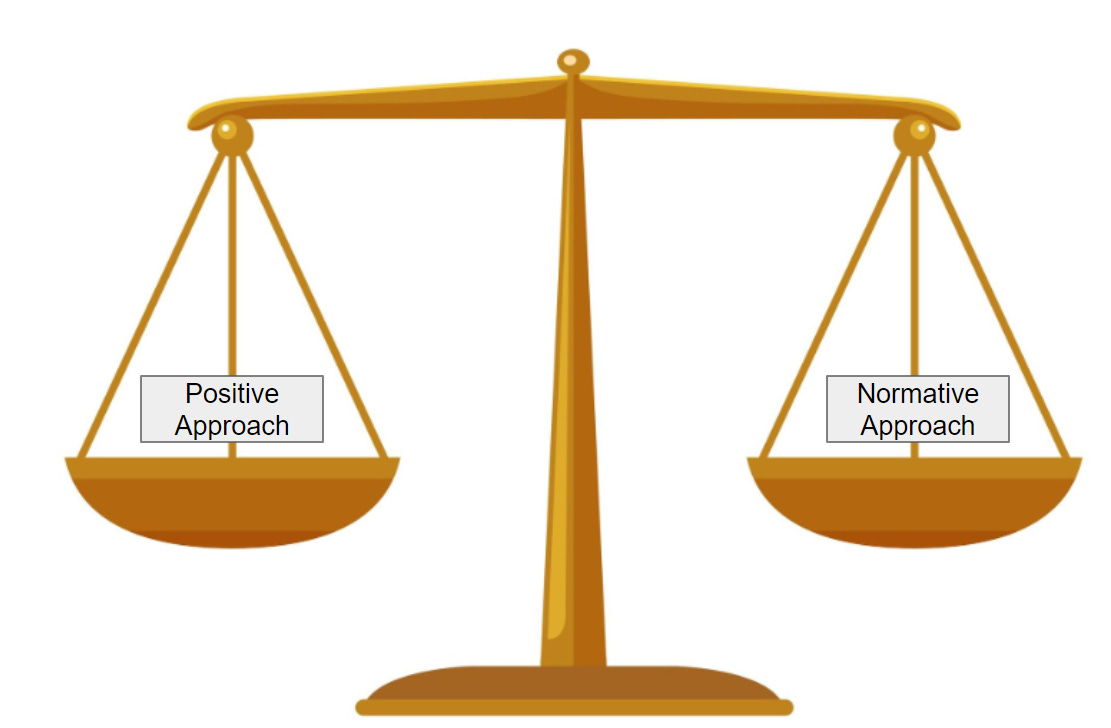
The interaction between the two is a special area of interest in policy making. In practice, the development and functioning of a country's system involve an interplay between Positive and Normative analyses. Positive analysis provides the factual basis for understanding potential policy impacts while Normative analysis guides the selection of policies based on societal values and goals.
For example: Consider President Trump’s policy of reducing corporate tax rates from 35% to 20% in 2017. Those from Positive branch of Liberal science such as agencies like Center for Budget Office (CBO) predicted the following in 2018:
Increase in budget deficit.
Increase in growth rate over 10 year by 0.7-0.8% as opposed to an economy with no tax cuts.
The net loss for a period of 10 year by Trump administration was expected to be ~$1.9 trillion. Politico’s calculation was ~$2.3 trillion dollars.
The administration and the Republican congress analysis finally passed the bill because of their Normative belief: “Taxes should be reduced to enhance economic growth, increase individual freedom, and limit the role of government in people's lives.”
However, if the Positive branch calculated the deficit to be $10 trillion, no amount of Normative pressure from Republican party would have passed the bill in US congress or senate as that would have been an unbearable deficit.
Similarly, if the senate and congress were controlled by Democrats, they wouldn’t have gone for corporate tax cuts even if the Positive branch calculated a surplus of $1 trillion because of their Normative belief: “Redistribution policies funded by higher corporate taxes will reduce poverty rates and support a more equitable distribution of wealth.”
For a policy or a law to be adopted by a country, it should have backing of both the Positive branch and the approval of Normative branch.
Lastly, don’t forget to check our daily short notes on Liberal sciences at (and subscribe us at):
https://mineglobal.substack.com/notes , OR,
https://www.facebook.com/profile.php?id=61562130750360, OR,
https://x.com/MINEGlobalLearn