
[IR2] International Relations: Levels of Analysis
"The study of international relations is a continuous effort to make sense of an ever-changing world" – Hedley Bull, scholar of international relations.

In the previous post, we discussed the basics of International Relations (IR), various actors involved, key concepts, power structures, and major Theoretical Frameworks (i.e. Realism, Idealism and Constructivism) for analyzing IR. Continuing with the discussion on IR, we will delve into different Levels of analysis in International Relations in this post.
The Levels of analysis framework in IR is a method used to examine and explain state behavior and international events. Political scientist Kenneth Waltz, in his books "Man, the State, and War" and "Theory of International Politics" proposed a three-tiered framework that has been widely accepted as the standard for analyzing IR and international politics. These Levels of analysis offer distinct perspectives from which analysts can study the complexities of IR and propose generalized theories. Within a given IR Theoretical Framework (such as realism, idealism, or constructivism), various theories are developed based on their focus on a specific level of analysis which is used to explain the broader nature of international relations and events. For instance, within the Realism framework, Classical-Realism emphasizes individual-level analysis, Neorealism concentrates on system-level analysis, and Neoclassical Realism includes state-level analysis in its focus.
Three Levels of Analysis:
Individual Level
This level examines the role of individuals, particularly key leaders, policymakers, and influential figures, in shaping international relations. The personal characteristics, beliefs, perceptions, and decision-making styles of leaders can have a significant impact on foreign policy decisions. How leaders perceive threats and opportunities, their psychological profiles, and their personal experiences can influence their actions on the international stage. For example, one can analyze the role of Winston Churchill or Adolf Hitler to understand the unfolding and outcome of World War II, or the impact of President John F. Kennedy in how the Cuban Missile Crisis ended.
State (Domestic) Level
This level examines the internal factors within states that influence their foreign policies and international behavior. The type of government (democracy, autocracy, etc.), the structure of political institutions, and the nature of domestic politics can shape how states behave internationally. A state's economic situation, level of development, and economic interests can drive its foreign policy. Public attitudes, nationalism, and national identity can influence state actions, especially in democracies where leaders are accountable to voters. For example, one can examine how domestic political pressures influenced the U.S. decision to invade Iraq in 2003 or how China's domestic economic priorities shaped its foreign policy.
Systemic (International) Level
This level focuses on the international system's structure and dynamics and their impact on a state’s behavior. In the absence of a central authority, states operate in a self-help environment, prioritizing their security and self-interest. In addition to the competition, the concept of cooperation also plays a key role in the international system. Power distribution among states (e.g., unipolarity, bipolarity, multipolarity) and balance of power dynamics shapes a state's actions and can determine the probable cause of conflict. International norms, laws, and institutions (e.g., the UN, treaties) influence state interactions and maintain order. For example, the Cold War exemplifies bipolarity, with power distribution between the U.S. and Soviet Union dictating global alliances and conflicts.
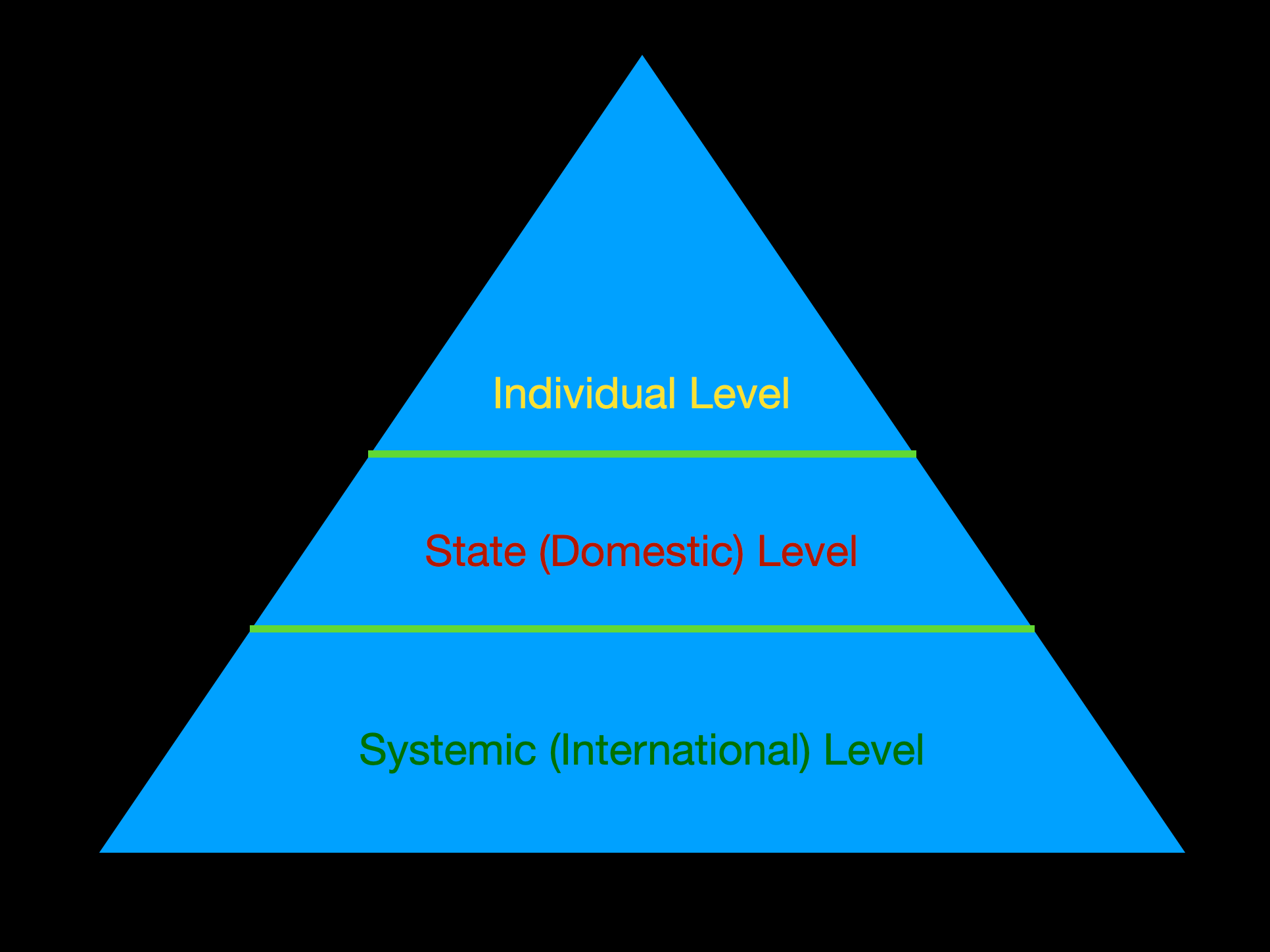
Summary:
Individual Level: Focuses on the actions and decisions of individual leaders and policymakers.
State Level: Looks at domestic factors, including political institutions, economic conditions, and public opinion, within a state.
Systemic Level: Considers the overall structure of the international system, including the distribution of power, anarchy, and the role of international institutions.
These three levels provide a comprehensive framework for understanding and analyzing complex international phenomena, from wars and alliances to diplomatic negotiations and global governance.
In the next post, we will analyze different IR theories based on different Theoretical Frameworks and different Levels of analysis.
Lastly, don’t forget to check our daily short notes on Liberal sciences at (and subscribe us at):
https://mineglobal.substack.com/notes , OR,
https://www.facebook.com/profile.php?id=61562130750360, OR,
https://x.com/MINEGlobalLearn