
Ethical Dilemmas: When Every Choice Has a Cost


Most people imagine ethics as a simple choice between right and wrong. While this may be true in many situations, real life is often more complicated. Some of the hardest moral questions, especially those involving collective human affairs, are not simply about choosing good over evil.
A government has enough money to fund either life-saving cancer treatment for a few thousand patients or basic vaccinations for millions of children. One choice saves identifiable lives in urgent need. The other prevents future suffering on a much larger scale. Which is the more ethical use of limited resources?
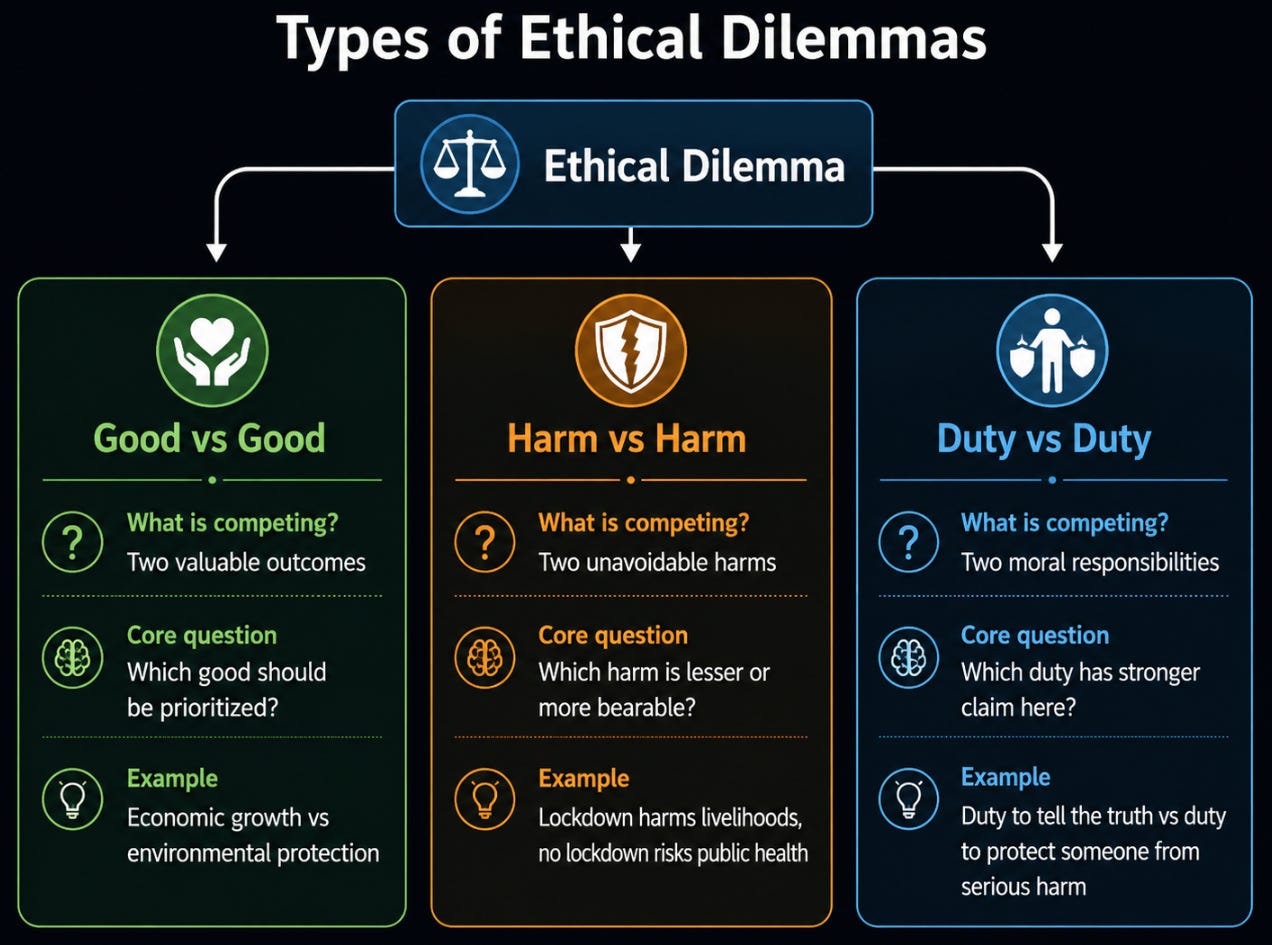
In such situations, none of the available choices are entirely good. Sometimes the choice is between preserving one good at the cost of another. At other times, it means choosing one duty over another responsibility, or accepting a lesser evil to avoid a greater harm. These complex situations, where every option involves some moral cost, are called ethical dilemmas.
Take the quiz after finishing the article to get on our leaderboard (With Google Signon).
Academic work on ethical dilemmas in classical moral philosophy was taken up by ancient thinkers like Aristotle who asked how practical wisdom judges between competing goods. Later traditions such as Kantian ethics and utilitarianism framed dilemmas as conflicts between duty and consequence. One choice may follow a moral duty, but lead to bad consequences. Another choice may produce better consequences, but violate a duty.
In the twentieth century, the topic became more formal: W. D. Ross’s The Right and the Good developed the idea of prima facie duties, where duties such as truthfulness, justice, beneficence, and non-maleficence may conflict. In analytic philosophy, Philippa Foot introduced the famous trolley problem, and Judith Jarvis Thomson later expanded it in connection with debates about the doctrine of double effect. More recently, these debates have extended into applied ethics, bioethics, business ethics, public policy, artificial intelligence, and autonomous vehicles, where dilemmas are studied as conflicts between goods, harms, rights, duties, and uncertain consequences.
Islamic thought has a long tradition of dealing with ethical dilemmas, especially through the disciplines of uṣūl al-fiqh, maqāṣid al-sharīʿah, and qawāʿid fiqhiyyah. Scholars such as al-Ghazālī discussed maṣlaḥah as the preservation of essential human interests, while al-Shāṭibī developed the maqāṣid framework around protecting religion, life, intellect, lineage, and wealth. Islamic legal maxims (qawāʿid fiqhiyyah) such as “harm must be removed,” “necessity permits exceptions,” and “the lesser harm is chosen to avoid the greater harm” show that Muslim jurists recognized moral life as involving complex choices, not merely simple obedience to rules.
Some Examples
A doctor may have limited medicine and must decide which patient receives it first.
A government may have to choose between national security and civil liberty.
A business may need to balance profitability, talent attraction through lucrative salaries, worker welfare, and affordability for customers.
In each case, the question is not simply, “What is right?” but “Which right should be prioritized, and what harm can be minimized?”
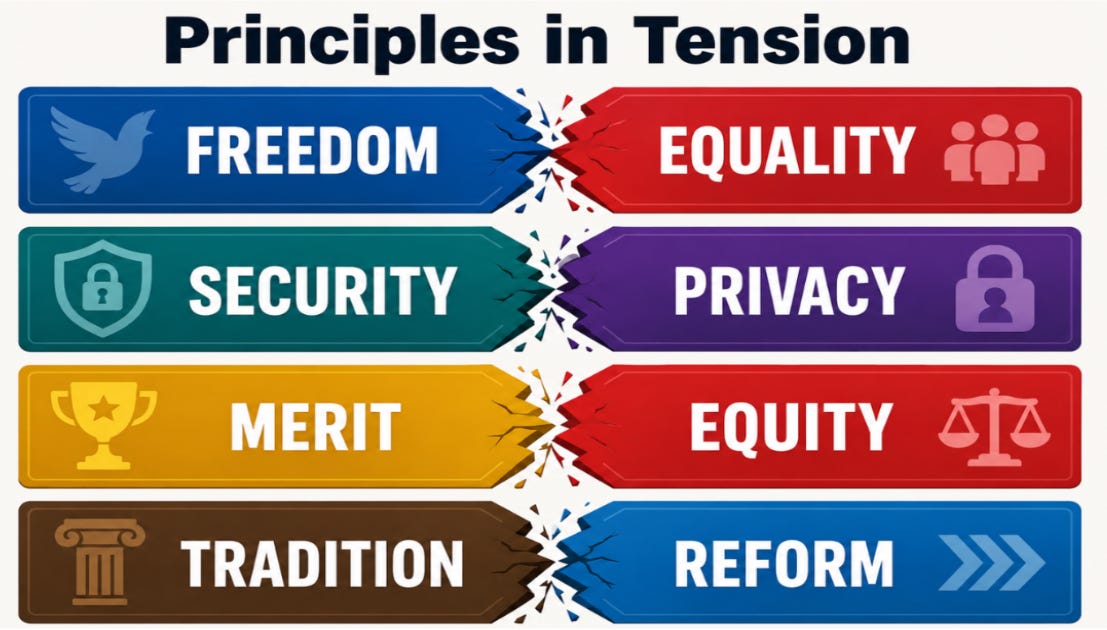
This is why ethical dilemmas are central to human affairs. At the personal level, they appear in family, friendship, work, money, marriage, and parenting. At the large-scale social level, they appear in law, economics, medicine, war, public policy, technology, and governance. Human life is complicated because values often collide. Justice may conflict with mercy. Freedom may conflict with equality and security. Loyalty may conflict with truth. Equality may conflict with efficiency. Compassion may conflict with rules. No serious moral framework can ignore this complexity.
Frameworks
Approaching a problem and developing a solution requires a framework. The defining feature of an ethical framework is what it emphasizes or prioritizes. Some frameworks focus on consequences, some on rules and duties, some on character, and others on rights, justice, care, or divine command. A few important frameworks to note are:
Utilitarianism
This is one of the most famous ways of approaching ethical dilemmas. It is closely associated with the work of Jeremy Bentham and John Stuart Mill. It starts by asking: which action produces the greatest good for the greatest number? A utilitarian approach is attractive because it looks at real-world consequences. If a government is deciding how to spend limited public money, utilitarian thinking asks where that money can reduce the most suffering or help the most people. In a hospital, it may support prioritizing patients who have the greatest chance of survival. Its strength is practicality. It forces us to look beyond intentions and measure results.
But utilitarianism also has a weakness. If taken too far, it can justify sacrificing the few for the benefit of the many. A society may argue that violating the rights of a small minority is acceptable if the majority benefits. This is morally dangerous. Human beings are not just numbers in a calculation. They have dignity, rights, and moral worth.
Deontology
Deontology, often associated with duty-based ethics, takes a different path. It asks: what is my moral duty, regardless of the outcome? Closely associated with the work of Immanuel Kant, the deontological approach emphasizes principles such as honesty, promise-keeping, justice, and respect for persons. For example, even if lying produces a convenient result, this framework may still say lying is wrong because truthfulness is a duty.
The strength of deontology is that it protects moral principles from being crushed by convenience. It reminds us that some lines should not be crossed, even for practical gain. But its weakness is rigidity. What happens when two duties conflict? Suppose telling the truth may endanger an innocent person. Should one still tell the truth? Real life often places duties against each other, and strict rule-based thinking may not always provide an easy answer.
Virtue ethics
With its roots in Aristotelian ethics, this approach shifts attention from rules and consequences to character. It asks: What would a virtuous person do? Instead of treating ethics as a checklist, virtue ethics sees moral life as the cultivation of the soul. A person must develop good judgment, not merely memorize rules.
This is especially useful in personal life. In family disputes, workplace tensions, or community disagreements, the issue is often not only the external action but the character behind it. Was I arrogant or humble? Was I just or vengeful? Was I courageous or cowardly? Virtue ethics reminds us that repeated choices shape who we become. Its weaknesses are:
(a) It may not always give a precise answer in urgent situations.
(b) Different virtues can also pull in different directions. Courage may demand speaking boldly, while wisdom may demand silence.
Rights-based ethics
The focus of this approach is on human dignity and individual protections. It asks: whose rights are being affected? Central to this approach are theories of justice and fairness, which address structural questions and social choices. In the West, thinkers like John Locke, John Rawls and Robert Nozick have written extensively in this tradition.
This framework is important in modern societies because powerful institutions can easily abuse individuals. A government may claim that surveillance protects society, but citizens may ask whether their privacy and freedom are being violated. A company may seek efficiency, but workers may ask whether their dignity and safety are being ignored. Theories of justice and fairness ask us to imagine society not only from our own position, but also from the position of the weak, poor, disabled, or marginalized. These questions are especially important at the institutional level. How should tax burdens be distributed? Who should receive healthcare first? Should education be funded equally or according to need?
The strength of rights-based ethics is that it protects people from being treated merely as tools. Its weakness is that rights can conflict. In fact, this is at the heart of many ethical disagreements at structural and societal levels. One person’s freedom of speech may conflict with another person’s right to dignity or safety. One person’s property rights may conflict with another person’s need for survival.
Care ethics
Care ethics emphasizes relationships, empathy, dependency, and responsibility. It asks: who is vulnerable, and what do I owe to those connected to me? This framework is deeply human because people are not isolated individuals. An individual is a child, parent, spouse, neighbor, citizen, worker, and believer. Much of life is built around care. Carol Gilligan and Nel Noddings are prominent thinkers in this tradition.
Care ethics is important because purely abstract theories can become cold. A mother caring for a sick child, a son helping an elderly parent, or a community supporting a grieving family may not be acting from calculation or rule alone. They are responding to human bonds. Yet care ethics also has limits. Care for one’s own group can become favoritism if it ignores justice toward outsiders.
Islamic ethics
The Islamic moral tradition does not view morality as merely a matter of human preference, social agreement, or cost-benefit calculation. It grounds ethics in accountability before Allah, purification of the soul, justice, mercy, intention, and the higher purposes of divine guidance. Islamic moral reasoning includes commands and prohibitions, but it also considers broader principles such as preventing harm, fulfilling trusts, protecting life, honoring contracts, serving the weak, preserving human dignity, and acting with taqwa.
This framework is valuable because it places human action within a larger moral universe. The central question is not only, “What benefits me?” or “What can I get away with?” but also, “What is pleasing to Allah, what is just, what harms or benefits others, and what will I be accountable for?”
Ultimately, the foundation of Islamic ethics is that the Creator of human beings is far more aware of the subtleties of life than human beings themselves.
When facing an ethical dilemma, Islamic reasoning often evaluates the issue through the maqāṣid al-sharīʿah, the higher objectives of Islamic law. These objectives seek to protect foundational human necessities, commonly listed as:
Faith (dīn)
Life (nafs)
Intellect (ʿaql)
Lineage and family (nasl)
Property and wealth (māl)
This does not mean that every dilemma is solved mechanically by a simple checklist. Rather, the maqāṣid provide a structured way to ask which essential goods are being protected, which harms are being prevented, and how competing duties should be prioritized. This approach is often combined with legal maxims such as “harm must be removed,” “necessity permits exceptions,” and “the lesser harm is chosen to avoid the greater harm.”
Ultimately, Islamic normative ethics combines obedience to divine command with concern for human welfare, justice, and consequences. It recognizes firm moral duties, but it also provides tools for dealing with complexity, necessity, competing harms, and public interest. In this sense, it offers a disciplined framework for ethical decision-making at both personal and societal levels.
At the same time, applying religious principles to modern dilemmas requires knowledge, wisdom, and humility. New technologies, financial systems, medical choices, and political structures often require careful reasoning and strategic foresight. In many cases, it takes several rounds of reflection and engagement before religious scholars and communities arrive at a mature response to dynamic changes in society, which can lead to lost years or even decades. Excessive caution can sometimes lead to long-term harm or cause communities to miss opportunities. While one may argue that moving too quickly can be more harmful than moving cautiously, excessive conservatism has also been counterproductive to Muslim empowerment.
Final Words
This post has only scratched the surface of ethical dilemmas, with the purpose of introducing the topic and revealing the complexity of human life. Ethical decisions are often difficult because human beings are complicated, society is interconnected, and every action has ripple effects. At a small scale, we face moral tensions in our homes and workplaces. At a large scale, societies and policymakers face dilemmas involving millions of people. A policy that helps one group may hurt another. A reform may solve one problem while creating another. A leader may need to choose between imperfect options. This does not mean ethics is meaningless but requires a lot more seriousness.
Even when people share a common ethical framework, they may still arrive at different solutions when facing a difficult moral dilemma. This is reflected in divergent Islamic rulings, where scholars may agree on broad principles but differ in how they apply those principles to specific cases. A mature person therefore does not ask only, “Which theory gives me the answer I already want?” Instead, they consider several ethical questions together and try to understand the framework used by those who reach different conclusions. Familiarity with ethical dilemmas should make us cautious about excessive confidence and the simplistic vilification of others.
Ethical dilemmas should make us humble, but they should not lead us to moral relativism. The fact that moral choices are sometimes difficult does not mean that all choices are equally valid. Rather, dilemmas remind us that serious moral reasoning requires carefully weighing various aspects of the chosen ethical framework.
Take the quiz to get on our leaderboard (With Google Signon).
 | A guest post by
|
Nice article. Jazakallahukhair.
Really brings up the problem of Naive thinking that there is only one right in every scenario.